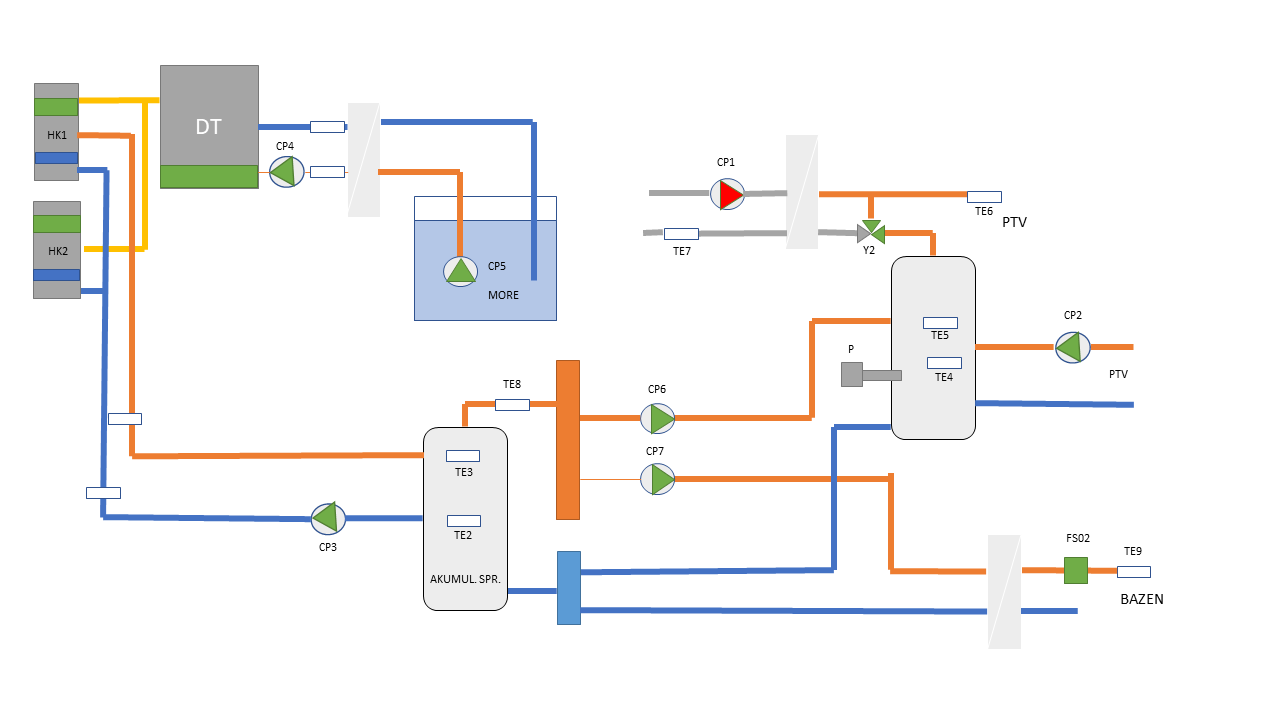
The recent Heating and Cooling Strategy from Commission indicated that emissions related to energy used for heating and cooling of buildings can be significantly reduced with technologies which use renewable energy sources and have high efficiency. Taking this into consideration the SEADRION project aim to support the development of a regional innovation system for the Adriatic-Ionian area with the installation of 3 renewable energy facilities in the public buildings located in Greece and western and south part of Adriatic Croatia. These facilities are seawater heat pump, an innovation system that uses the thermal energy contained in a reservoir (sea) to achieve the cooling and thermal energy in the buildings which are close to the sea. The main objective of the SEADRION is to identify benefits and barriers associated with the use of this technology and to find a system solution designed to improve the use of the seawater heat pump technology and to make the building's energy self-sufficient and independent of fossil fuels.
The main outputs of the SEADRION project are transnational seawater heat pump network to support sustainable development in ADRION region, science and technology cooperation between research institutions and enterprises to enhance innovation capacity of the heat pump sector with the aim to enhance their innovation skills, capacities and competencies and common strategy to enhance the use of seawater heat pump based heating and cooling in ADRION region.
The development of a business support network with innovative features, training as well as mediation and networking between enterprises will facilitate the specific innovation transfer and will increase the competitiveness of its members.
-
City of Šibenik
Šibenik is a historic city in Croatia, located in central Dalmatia where the river Krka...
-

Institute Jozef Stefan/ Energy Efficient Centre
The Centre is the key actor for the development, collection and transfer of knowledge...
-
Municipality of Crotone
Five years ago the city of Crotone carried out a plan for the adoption of innovative...
-

Astir Egnatia Alexandroupoli Hotel
Hotel is on the coast of Alexandroupolis and could be a potential user of this technology...
-

Klima 2000 d.o.o.
...
-

PROFESION KLIMA
PROFESION KLIMA creates maximum comfort by providing solutions, products, systems and...
-

Financial Agency (Fina)
Fina will be informed about the potentials of the seawater heat pumps with the hope to...
-

The county council of Durres
The county council of Durres will help us promote a potential future pilot plant and...
-
Idrosistemi srl
Idrosistemi Ecot Group can assume an important value to carry out the design of integrated...
-

Vailant d.o.o.
As part of the Vaillant Group, Vaillant d.o.o. will offer their expertise with heat pump...
-

Energy HIVE Cluster
ENERGY HIVE cluster’s vision is to strengthen and promote regional stakeholders engagement...
-

Municipality Omišalj
Omišalj is a coastal municipality in the north-west of the island of Krk in Croatia...
-

Klimaproing d.o.o.
Klimaproing has experience in wide variety of activities including design, technical...
-

Clivet S.p.A.
The company has a wide experience in heat pump installations. Clivet built numerous plants...
SEADRION materials
Download digital materials related to the project
SEADRION: Seawater heat pump operation experience
“SEADRION – Seawater heat pump operation experience” will be held via ZOOM Video Webinar on Tuesday, July 27th 2021. from 10:00 to 11:00 AM